
3 条题解
-
7
乱搞题依旧 tzq 专长。
题解真是拉完了,我们直接考虑打表。可以写出:
#include <bits/stdc++.h>
using namespace std;
#define int long long
const int N=105;
int n,vis[N],a[N],b[N],anss=0;
void work()
{
    int ans1=0;
    memset(b,0,sizeof b);
    for(int i=1; i<=n; i++)
    {
        b[a[i]]=1;
        for(int j=a[i]+1; j<=n; j++)ans1+=b[j];
    }
    if(ans1!=n-1)return;
    for(int k=1; k<n; k++)
    {
        for(int i=1; i<=k; i++)b[i]=a[i];
        sort(b+1,b+k+1);
        int ans1=0;
        for(int i=1; i<=k; i++)ans1+=(b[i]==i);
        if(ans1==k)return;
    }
    for(int i=1; i<=n; i++)cout<<a[i]<<' ';
    cout<<'\n';
    for(int i=n-3; i>=0; i--)cout<<((anss>>i)&1)<<' ';
    cout<<'\n';
    anss++;
}
void dfs(int x)
{
    if(x==n+1)
    {
        work();
        return;
    }
    for(int i=1; i<=n; i++)
    {
        if(!vis[i])
        {
            vis[i]=1;
            a[x]=i;
            dfs(x+1);
            vis[i]=0;
        }
    }
}
signed main()
{
    cin>>n;
    dfs(1);
    return 0;
}
以上代码输出所有的方案和对应的 的值。
当 时输出:2 3 4 5 6 7 1 0 0 0 0 0 2 3 4 5 7 1 6 0 0 0 0 1 2 3 4 6 1 7 5 0 0 0 1 0 2 3 4 7 1 5 6 0 0 0 1 1 2 3 5 1 6 7 4 0 0 1 0 0 2 3 5 1 7 4 6 0 0 1 0 1 2 3 6 1 4 7 5 0 0 1 1 0 2 3 7 1 4 5 6 0 0 1 1 1 2 4 1 5 6 7 3 0 1 0 0 0 2 4 1 5 7 3 6 0 1 0 0 1 2 4 1 6 3 7 5 0 1 0 1 0 2 4 1 7 3 5 6 0 1 0 1 1 2 5 1 3 6 7 4 0 1 1 0 0 2 5 1 3 7 4 6 0 1 1 0 1 2 6 1 3 4 7 5 0 1 1 1 0 2 7 1 3 4 5 6 0 1 1 1 1 3 1 4 5 6 7 2 1 0 0 0 0 3 1 4 5 7 2 6 1 0 0 0 1 3 1 4 6 2 7 5 1 0 0 1 0 3 1 4 7 2 5 6 1 0 0 1 1 3 1 5 2 6 7 4 1 0 1 0 0 3 1 5 2 7 4 6 1 0 1 0 1 3 1 6 2 4 7 5 1 0 1 1 0 3 1 7 2 4 5 6 1 0 1 1 1 4 1 2 5 6 7 3 1 1 0 0 0 4 1 2 5 7 3 6 1 1 0 0 1 4 1 2 6 3 7 5 1 1 0 1 0 4 1 2 7 3 5 6 1 1 0 1 1 5 1 2 3 6 7 4 1 1 1 0 0 5 1 2 3 7 4 6 1 1 1 0 1 6 1 2 3 4 7 5 1 1 1 1 0 7 1 2 3 4 5 6 1 1 1 1 1可以发现,第一个形如
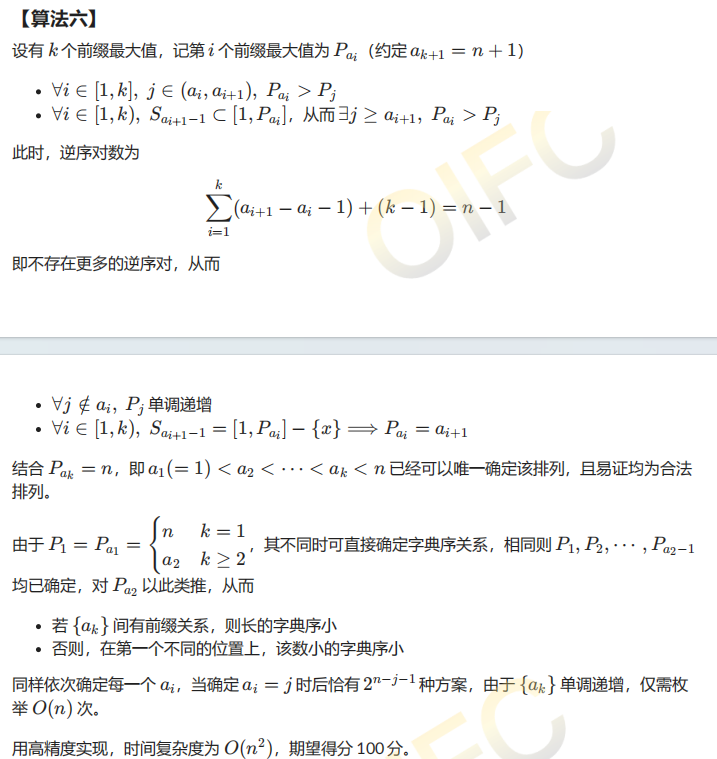
1 1 ... 1 0的二进制段,假设其 的个数为 ,则前 个数的方案为 。选取
3 1 5 2 7 4 6,其 值的后面 位为 ,对应 的方案为3 1 5 2 4,发现这和5 2 7 4 6相对顺序相同,不难想到直接递归即可。具体地,你在选数时选择当前还未选择的第 和 大的数即可。
对 做除二操作, 模拟上述过程,时间复杂度 。Code:
#include<bits/stdc++.h> using namespace std; #define int long long const int N=50005; int n,v[N],vis[N];//二进制从低到高第i位 struct bigint { int a[N]; } k,now,U; bigint read() { bigint x=U; char c=getchar(); for(; c<'0'||c>'9'; c=getchar()); for(; c>='0'&&c<='9'; c=getchar()) { for(int i=N-1; i; i--)x.a[i]=x.a[i-1]; x.a[0]=c^48; } return x; } int div2(bigint x) { int g=x.a[0]&1; for(int i=N-1; i>=0; i--) { int z=x.a[i]; if((z&1)&&i)x.a[i-1]+=10; x.a[i]/=2; } now=x; return g; } bigint del1(bigint x) { int now=0; while(1) { x.a[now]--; if(x.a[now]<0) { x.a[now]+=10; now++; } else break; } return x; } void sol() { cin>>n; k=del1(read()); for(int i=1; i<=n-2; i++) { v[i]=div2(k); k=now; } //for(int i=n-2;i>=1;i--){cout<<v[i]<<' ';} for(int i=n-2; i>=1; i--) { int w=0; while(v[i-w]==1)w++; int cnt=0,nw=0; for(int j=1; j<=n; j++) { if(cnt==w+2)break; if(vis[j]==0) { cnt++; nw=j; } } cout<<nw<<' '; vis[nw]=1; cnt=0; for(int j=1; j<=n; j++) { if(cnt==w)break; if(vis[j]==0) { cnt++; cout<<j<<' '; vis[j]=1; } } i=i-w; } if(vis[n]==0)cout<<n<<' '; for(int j=1; j<n; j++)if(vis[j]==0)cout<<j<<' '; } signed main() { freopen("permutation.in","r",stdin); freopen("permutation.out","w",stdout); int t=1; while(t--)sol(); return 0; } -
1
找规律
===== n = 2 =====
2 1
===== n = 3 =====
2 3 1
3 1 2
===== n = 4 =====
2 3 4 1
2 4 1 3
3 1 4 2
4 1 2 3
===== n = 5 =====
2 3 4 5 1
2 3 5 1 4
2 4 1 5 3
2 5 1 3 4
3 1 4 5 2
3 1 5 2 4
4 1 2 5 3
5 1 2 3 4
===== n = 6 =====
2 3 4 5 6 1
2 3 4 6 1 5
2 3 5 1 6 4
2 3 6 1 4 5
2 4 1 5 6 3
2 4 1 6 3 5
2 5 1 3 6 4
2 6 1 3 4 5
3 1 4 5 6 2
3 1 4 6 2 5
3 1 5 2 6 4
3 1 6 2 4 5
4 1 2 5 6 3
4 1 2 6 3 5
5 1 2 3 6 4
6 1 2 3 4 5
发现第一个数为 的方案数为
总方案数为
将 的对应反转一下变为
2 3 4 5 6 1 10000
2 3 4 6 1 5  1111
2 3 5 1 6 4  1110
2 3 6 1 4 5  1101
2 4 1 5 6 3  1100
2 4 1 6 3 5  1011
2 5 1 3 6 4  1010
2 6 1 3 4 5  1001
3 1 4 5 6 2  1000
3 1 4 6 2 5   111
3 1 5 2 6 4   110
3 1 6 2 4 5   101
4 1 2 5 6 3   100
4 1 2 6 3 5    11
5 1 2 3 6 4    10
6 1 2 3 4 5     1
太史了 再减
2 3 4 5 6 1  1111
2 3 4 6 1 5  1110
2 3 5 1 6 4  1101
2 3 6 1 4 5  1100
2 4 1 5 6 3  1011
2 4 1 6 3 5  1010
2 5 1 3 6 4  1001
2 6 1 3 4 5  1000
3 1 4 5 6 2   111
3 1 4 6 2 5   110
3 1 5 2 6 4   101
3 1 6 2 4 5   100
4 1 2 5 6 3    11
4 1 2 6 3 5    10
5 1 2 3 6 4     1
6 1 2 3 4 5     0
发现规律
第一个为 ,然后为 到 ,后面的数也是求排列,递归下去处理
#include <bits/stdc++.h> using namespace std; using ll = long long; const int N = 5002; int n; string _K; int K[N], Kl, nb; int l, a[N]; set <int> st; // 这个是为了方便求递归下去的排列对应的数 vector <int> ans; inline void solve(int w){ vector <int> v; for(auto s : st){ v.push_back(s); } if(!w){ // 赛时脑子抽了写的,可以删掉 ans.push_back(v[1]); ans.push_back(v[0]); return; } for(int i = 1; i <= w; ++ i){ // 这里是找当前排列的第一个数是什么 if(a[w - i]){ ans.push_back(v[i]); st.erase(v[i]); for(int j = 0; j <= i - 2; ++ j){ ans.push_back(v[j]); st.erase(v[j]); } solve(w - i); return; } } // 后面没有排列了,不用递归 w = v.size() - 1; ans.push_back(v[w]); for(int i = 0; i < w; ++ i){ ans.push_back(v[i]); } } int main(){ freopen("permutation.in", "r", stdin); freopen("permutation.out", "w", stdout); ios::sync_with_stdio(0), cin.tie(0), cout.tie(0); cin >> n >> _K; Kl = _K.size() - 1; for(int i = 0; i <= Kl; ++ i){ K[i] = _K[Kl - i] - '0'; } -- K[0]; for(int i = 0; i <= Kl && K[i] < 0; ++ i){ -- K[i + 1]; K[i] += 10; } if(Kl && !K[Kl]) -- Kl; l = -1; while(K[Kl]){ nb = 0; for(int i = Kl; i >= 0; -- i){ nb = (nb ? 10 : 0) + K[i]; K[i] = nb >> 1; nb &= 1; } a[++ l] = nb; while(Kl && !K[Kl]) -- Kl; } l = max(0, l); for(int i = 0; i < n - 2; ++ i){ a[i] ^= 1; } // 前面都是 k 转二进制 for(int i = 1; i <= n; ++ i){ st.insert(i); } solve(n - 2); for(auto s : ans) cout << s << ' '; return 0; } /* g++ permutation.cpp -o permutation -lm -O2 -std=c++14 -Wall ./permutation */ -
-6
puck @ 2026-10-7 9:09:01

 C2023TanZQ
LV 4
@ 2026-10-7 13:44:29

- 1